The leader / design track 🤝 · for C-level & upper management · 6 x 45 min · no code, ever
Thinking mode: how to design a measurement system that is fair and hard to game - what OKRs are and are not, the metric tree, the biases to guard against, how to govern AI in measurement, and the culture that makes it work. Each session ends with the questions to ask your team.
Why measure, and the trap
The promise and the peril of measuring people - "what gets measured gets managed", and Goodhart's warning that any target gets gamed.
🎯 Leader 2 · easyOKRs vs KPIs vs metrics
The language of goals: objectives and key results, change vs health, and the Cartwheel metric tree where revenue = sessions x conversion x order value.
🌿 Leader 3 · mediumControllable levers + attribution
Decompose goals until each branch has an owner, grade what a team controls, and watch shared outcomes together - the attribution problem, solved.
⚖️ Leader 4 · mediumFair-measurement principles
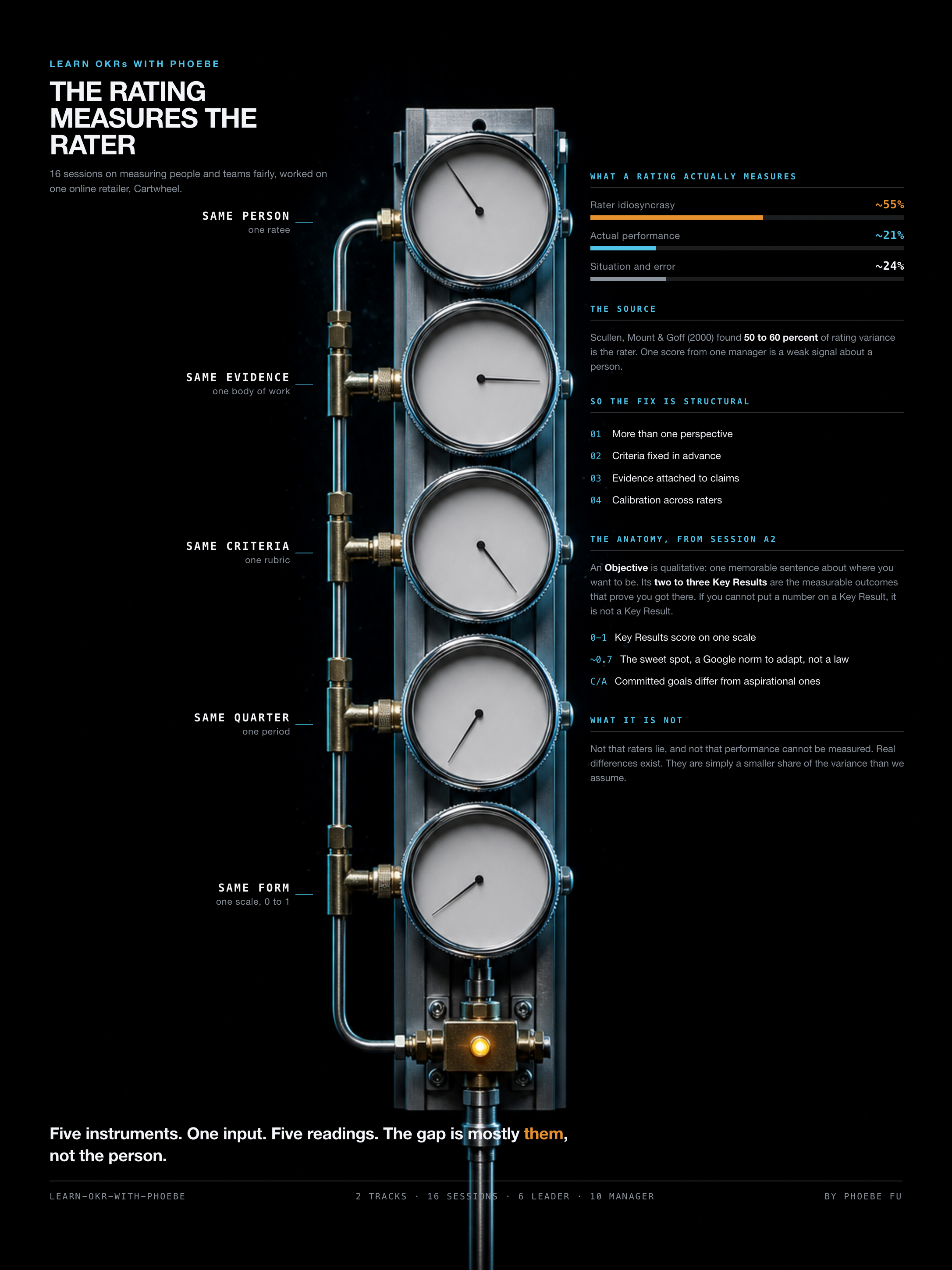
Why ratings say more about the rater than the rated, how bias hides in feedback language, the three kinds of justice, and why OKRs must be decoupled from pay.
🤖 Leader 5 · decidingAI in measurement
Where AI genuinely helps versus where it becomes surveillance - the Microsoft and Amazon cautionary tales, plus the EU AI Act, GDPR, and NYC bias-audit rules.
🧭 Leader 6 · decidingRollout, cadence & culture
The monitoring cadence, psychological safety, separating steering from reward, and a maturity roadmap - plus when NOT to measure at all.
The manager / run track 🛠️ · for middle management & team leads · 10 x 45 min · templates + worked examples
One running company, Cartwheel, threaded through the demos: you write real OKRs, choose metrics that are fair to grade on, set a monitoring cadence, run fair performance conversations, and use AI responsibly - following one team from goal-setting to a full measurement system.
Foundations
The three purposes of measurement, activity vs outcome, and the six-point fair-metric checklist you will use all track.
✍️ Manager 2 · easyWriting good OKRs
Objectives that inspire and key results that prove it, committed vs stretch, the 0-1 scoring scale, and the ~0.7 sweet spot.
⚗️ Manager 3 · mediumChoosing fair metrics
Score a metric's fairness, then watch Goodhart's Law break it - a live Fair-Metric Lab where a gamed number climbs while the real outcome collapses.
🌳 Manager 4 · mediumThe metric tree per function
Fair OKRs for every Cartwheel team - Growth, Product, Engineering (DORA), Ops, Support, Merchandising, Data - each on a lever it controls.
📊 Manager 5 · mediumMonitoring cadence + dashboards
1:1s tuned to task-relevant maturity, weekly-monthly-quarterly rhythm, and dashboards that show target, trend, and context - not naked numbers.
💬 Manager 6 · hands-onFair performance conversations
Continuous check-ins over the annual review, and keeping steering, development, and reward in separate conversations so honesty survives.
🎭 Manager 7 · hands-onBeating the bias
The idiosyncratic rater effect, recency and halo, biased feedback language, and calibration done fairly - plus auditing your own ratings.
🤖 Manager 8 · hands-onAI-assisted, responsibly
Using AI to summarize feedback, flag biased language, and draft - with the guardrails: transparency, contestability, and what to never automate.
⚠️ Manager 9 · mediumWhen metrics go wrong
Gaming, surrogation, vanity metrics, and single-number verdicts - how to diagnose a broken metric and repair it before it does damage.
🏛️ Manager 10 · hardestBuild your measurement system
The capstone: assemble a full fair OKR and monitoring system for a Cartwheel team, with health guardrails, a cadence, and a review of the measures themselves.
Choose your path 🗺️
Two doors, one course. Leaders design the system; managers run it fairly - and both meet at the Fair-Metric Lab. Employees are welcome to read either as knowledge-sharing.
The knowledge map 🧠
Both tracks at a glance - hover a session to spotlight its concepts, click any node to jump in.
The plate: the rating measures the rater 📐
Five identical instruments, one shared input, five different readings. The uncomfortable finding under fair measurement, with the variance decomposition and the structural fix. Every word on the plate is real text.