The leader track 🤝 · for C-level, managers & curious minds · 6 x 45 min · no code, ever
Thinking mode: what RAG actually is, when it beats fine-tuning, what it costs, how to judge whether a RAG system is trustworthy, and how to govern it - each session ends with questions to ask your data team.
What RAG is, and why it beats a bigger prompt
Retrieval in plain English, RAG vs fine-tuning vs long-context, and the one question that tells you when RAG pays off.
🧩 Leader 2 · easyAnatomy of a RAG system
The nine moving parts you fund - ingest, chunk, embed, store, retrieve, rerank, generate, cite, evaluate - each as the question it lets you ask.
💰 Leader 3 · mediumCost vs quality: the real tradeoffs
Where money goes, where quality is won, build vs buy, and the levers that move accuracy without moving the bill much.
📊 Leader 4 · mediumHow to judge a RAG system
Groundedness, citations, hallucination, retrieval quality - the RAG Triad scorecard you demand before you trust an answer.
🛡️ Leader 5 · decidingRisk & governance
PII in embeddings, who-can-retrieve-what, stale answers, vendor lock-in, and refusal as a control you can insist on.
🗺️ Leader 6 · decidingFrom POC to production
The roadmap, the team, RAG vs agents, and where retrieval is heading in 2026 - contextual retrieval and agentic RAG.
The builder track 🛠️ · for practitioners · 10 x 45 min · Python + a browser playground
One growing artifact: Recall, a retrieval assistant. Every session upgrades the same system - and every idea is felt in the in-browser playground first, so the vector database never gets to be magic.
Embeddings 101
What a vector is, why cosine similarity ranks meaning, and why questions rarely share words with their answers. Live playground.
✂️ Builder 2 · easyChunking strategies
Fixed, recursive, semantic, sentence-window, parent-document - size and overlap, and why a bad chunk sinks good retrieval.
🗄️ Builder 3 · mediumVector databases
Chroma end to end - client, collection, add, query - then the pgvector and FAISS deltas, and HNSW vs IVF vs flat.
🔎 Builder 4 · mediumRetrieval basics
top-k similarity search, the retriever interface, and how to read a ranked result set with a critical eye.
🏷️ Builder 5 · hands-onMetadata + hybrid retrieval
where-filters, temporal queries over dated incidents, and dense + sparse/BM25 hybrid with the alpha lever.
🎚️ Builder 6 · hands-onReranking
Bi-encoder vs cross-encoder, retrieve-wide-then-rerank-narrow, MMR diversity, and query expansion / HyDE.
📎 Builder 7 · hands-onGrounding & citations
Answer only from context, cite the source, and the refuse-when-unknown guardrail that kills the confident wrong answer.
🔗 Builder 8 · hardestThe full pipeline
Wire retrieve → augment → generate with the Claude API, and stream one cited, grounded answer end to end.
🧪 Builder 9 · hardestRAG evaluation
A golden set, faithfulness, answer relevancy, context precision and recall, hit-rate and MRR, and the LLM-as-judge.
🚀 Builder 10 · hardestProduction RAG
Re-indexing and freshness, caching, the latency budget, monitoring, and cost - then the handoff to LangChain.
The running project: three escalating corpora 📚
The builder track grows one assistant, Recall, over the same three document sets - each harder to retrieve well than the last.
An MD's chief-of-staff notes
Emails, board notes, travel prefs. Pure semantic search: "what did I commit to in the Q2 board call?" Sessions b1-b4.
Dated Jira incident tickets
Each ticket has a date and a severity. Now retrieval needs metadata and time: "what SEV1s happened in March?" Sessions b5-b6.
A help-center for a support bot
Policy articles a customer bot answers from - grounded, cited, and willing to say "I don't know". Sessions b7-b10.
Choose your path 🗺️
Two doors, one course. Leaders never see code; builders never sit through theory they have not first felt in the playground.
The knowledge map 🧠
Both tracks at a glance - hover a session to spotlight its concepts, click any node to jump in.
The whole course on one sheet 📐
Seven modules: both tracks, the refusal that makes RAG trustworthy, the pipeline stage by stage, the builder ladder from embeddings to production, where retrieval quietly fails, and what good actually means when you measure it.
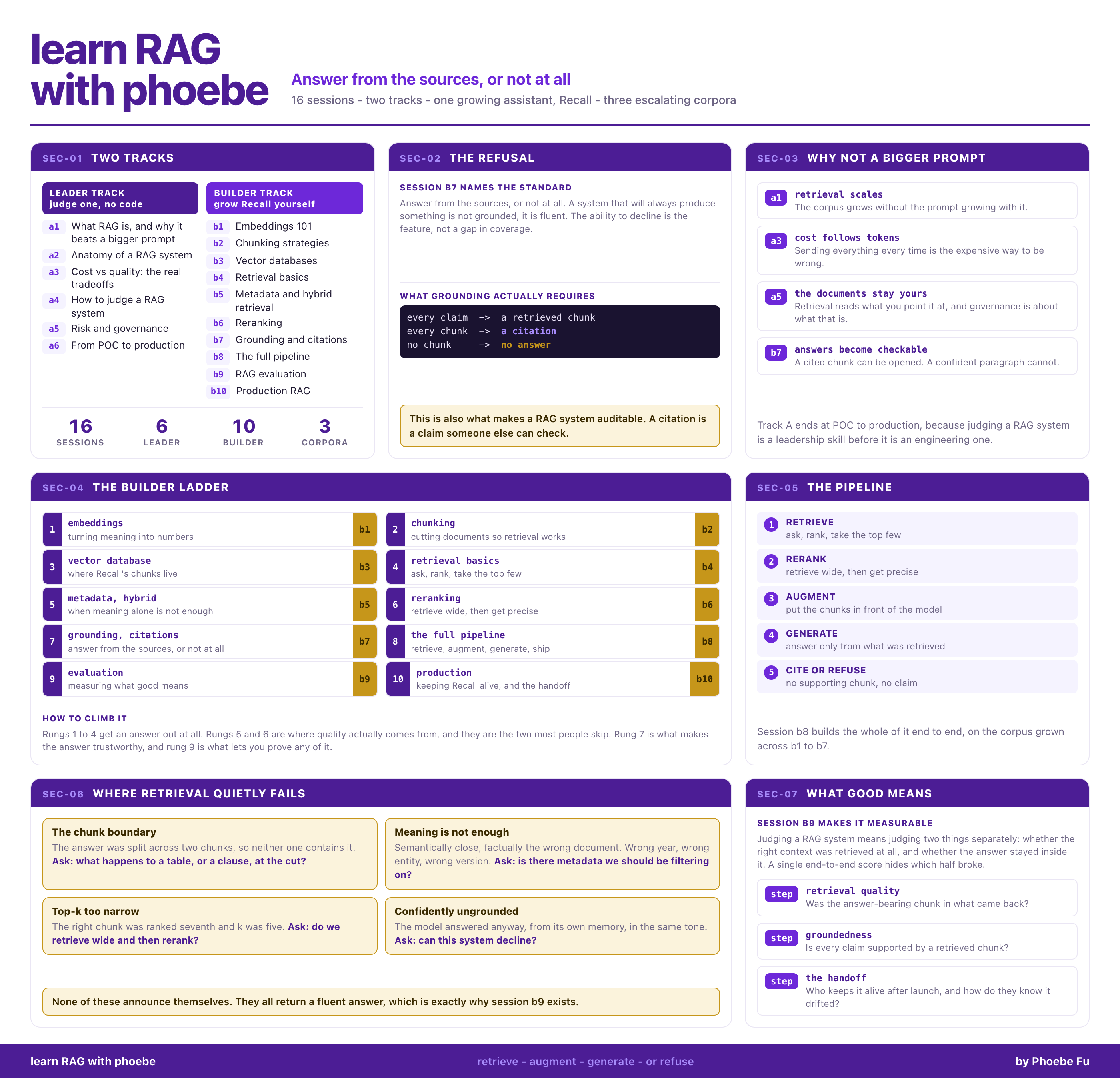
learn RAG
with phoebe
SEC-01 TWO TRACKS
LEADER TRACK
judge one, no code
- a1What RAG is, and why it beats a bigger prompt
- a2Anatomy of a RAG system
- a3Cost vs quality: the real tradeoffs
- a4How to judge a RAG system
- a5Risk and governance
- a6From POC to production
BUILDER TRACK
grow Recall yourself
- b1Embeddings 101
- b2Chunking strategies
- b3Vector databases
- b4Retrieval basics
- b5Metadata and hybrid retrieval
- b6Reranking
- b7Grounding and citations
- b8The full pipeline
- b9RAG evaluation
- b10Production RAG
SEC-02 THE REFUSAL
Answer from the sources, or not at all. A system that will always produce something is not grounded, it is fluent. The ability to decline is the feature, not a gap in coverage.
SEC-03 WHY NOT A BIGGER PROMPT
SEC-04 THE BUILDER LADDER
Rungs 1 to 4 get an answer out at all. Rungs 5 and 6 are where quality actually comes from, and they are the two most people skip. Rung 7 is what makes the answer trustworthy, and rung 9 is what lets you prove any of it.
SEC-05 THE PIPELINE
SEC-06 WHERE RETRIEVAL QUIETLY FAILS
SEC-07 WHAT GOOD MEANS
Judging a RAG system means judging two things separately: whether the right context was retrieved at all, and whether the answer stayed inside it. A single end-to-end score hides which half broke.