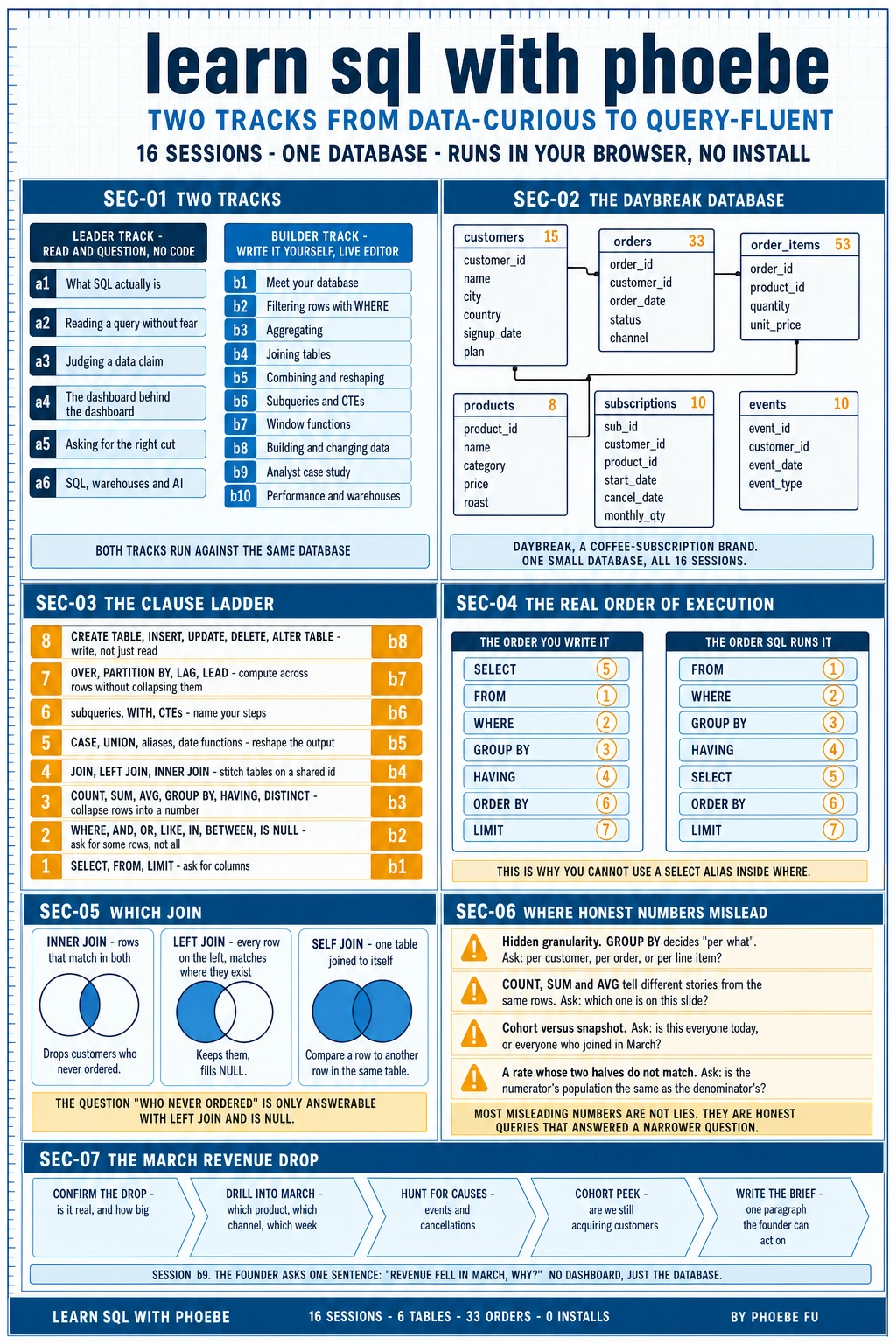
Read the poster as text (every label, in order)
learn sql with phoebe - course reference poster
Two tracks from data-curious to query-fluent
16 sessions - one database - runs in your browser, no install

SEC-01  TWO TRACKS
Leader track, read and question, no code:
  a1 What SQL actually is
  a2 Reading a query without fear
  a3 Judging a data claim
  a4 The dashboard behind the dashboard
  a5 Asking for the right cut
  a6 SQL, warehouses and AI
Builder track, write it yourself, live editor:
  b1 Meet your database
  b2 Filtering rows with WHERE
  b3 Aggregating
  b4 Joining tables
  b5 Combining and reshaping
  b6 Subqueries and CTEs
  b7 Window functions
  b8 Building and changing data
  b9 Analyst case study
  b10 Performance and warehouses
Both tracks run against the same database.

SEC-02  THE DAYBREAK DATABASE
Daybreak is a coffee-subscription brand. One small database, all 16 sessions.
  customers, 15 rows: customer_id, name, city, country, signup_date, plan
  products, 8 rows: product_id, name, category, price, roast
  orders, 33 rows: order_id, customer_id, order_date, status, channel
  order_items, 53 rows: order_id, product_id, quantity, unit_price
  subscriptions, 10 rows: sub_id, customer_id, product_id, start_date, cancel_date, monthly_qty
  events, 10 rows: event_id, customer_id, event_date, event_type
Relationships: customers to orders on customer_id, orders to order_items on order_id,
products to order_items on product_id, customers to subscriptions on customer_id,
customers to events on customer_id.

SEC-03  THE CLAUSE LADDER
  1  SELECT, FROM, LIMIT - ask for columns - b1
  2  WHERE, AND, OR, LIKE, IN, BETWEEN, IS NULL - ask for some rows, not all - b2
  3  COUNT, SUM, AVG, GROUP BY, HAVING, DISTINCT - collapse rows into a number - b3
  4  JOIN, LEFT JOIN, INNER JOIN - stitch tables on a shared id - b4
  5  CASE, UNION, aliases, date functions - reshape the output - b5
  6  subqueries, WITH, CTEs - name your steps - b6
  7  OVER, PARTITION BY, LAG, LEAD - compute across rows without collapsing them - b7
  8  CREATE TABLE, INSERT, UPDATE, DELETE, ALTER TABLE - write, not just read - b8

SEC-04  THE REAL ORDER OF EXECUTION
The order you write it, with the step it actually runs at:
  SELECT (5), FROM (1), WHERE (2), GROUP BY (3), HAVING (4), ORDER BY (6), LIMIT (7)
The order SQL runs it:
  1 FROM, 2 WHERE, 3 GROUP BY, 4 HAVING, 5 SELECT, 6 ORDER BY, 7 LIMIT
This is why you cannot use a SELECT alias inside WHERE.

SEC-05  WHICH JOIN
  INNER JOIN, rows that match in both. Drops customers who never ordered.
  LEFT JOIN, every row on the left, matches where they exist. Keeps them, fills NULL.
  SELF JOIN, one table joined to itself. Compare a row to another row in the same table.
The question "who never ordered" is only answerable with LEFT JOIN and IS NULL.

SEC-06  WHERE HONEST NUMBERS MISLEAD
  Hidden granularity. GROUP BY decides "per what". Ask: per customer, per order, or per line item?
  COUNT, SUM and AVG tell different stories from the same rows. Ask: which one is on this slide?
  Cohort versus snapshot. Ask: is this everyone today, or everyone who joined in March?
  A rate whose two halves do not match. Ask: is the numerator's population the same as the denominator's?
Most misleading numbers are not lies. They are honest queries that answered a narrower question.

SEC-07  THE MARCH REVENUE DROP
  1 Confirm the drop: is it real, and how big
  2 Drill into March: which product, which channel, which week
  3 Hunt for causes: events and cancellations
  4 Cohort peek: are we still acquiring customers
  5 Write the brief: one paragraph the founder can act on
Session b9. The founder asks one sentence: "Revenue fell in March, why?" No dashboard, just the database.

16 sessions - 6 tables - 33 orders - 0 installs
by Phoebe Fu