The leader track 🤝 · for execs, PMs & marketers · 6 x 45 min · no code
A model is only as trustworthy as the reading you give it. This track teaches you to tell a real ML use case from a fad, to read a confusion matrix and an ROC curve, to catch the accuracy paradox before it fools your team, and to commission ML work responsibly - all without opening a notebook. A friendly on-ramp for LinkedIn readers, too.
What ML actually is (and isn't)
Machine learning vs rules and dashboards, the three kinds of learning, prediction vs causation, and when NOT to use ML. The workflow every model follows, in plain language.
📉 Leader session 2How a model learns, and how it goes wrong
Learning from examples, the train/test idea, and the two ways every model fails - overfitting and underfitting - plus the bias-variance tradeoff, seen live, with no math to do.
🧱 Leader session 3The data is the model
Features and labels, garbage-in-garbage-out, and data leakage - the silent killer where a feature secretly contains the answer. Why more columns is not more signal.
🩺 Leader session 4Reading a model's report card
The accuracy paradox, the confusion matrix, precision vs recall, ROC-AUC, and RMSE in dollars - what every model metric means and which one to ask for. Threshold as a business choice.
🔗 Leader session 5Prediction is not proof
The model zoo at a glance - regression, trees, ensembles, neural nets, clustering - and the line every leader must hold: a model predicts, it does not prove cause. The bridge to experimentation.
⚖️ Leader session 6Putting ML to work responsibly
The lifecycle after launch - monitoring and drift - fairness and bias, buy vs build, and the questions to ask your data team. Capstone: read a Lumen model card like an exec.
The builder track 🛠️ · for practitioners · 10 x 45 min · Python + scikit-learn
For DA, DE, DS, and anyone who needs to actually train and judge a model. One running brand - Lumen Skincare - carried across every session: simulate it, split it, fit a first classifier and a first regressor, diagnose over- and under-fitting, cross-validate, measure it honestly, pipeline the preprocessing to kill leakage, and finish by comparing models and picking one. Built with scikit-learn, numpy, and pandas.
Setup and your first dataset
scikit-learn, pandas, numpy - and the Lumen dataset built once with seed 42 (reused all course long). Meet the fit / predict estimator API that every model shares.
The train/test split (and the leakage trap)
train_test_split, stratify for imbalanced targets, and the rule you never break: fit on train only. The scaler-on-test disaster, shown in real numbers.
Your first model, end to end
LogisticRegression to predict who converts - fit, predict, predict_proba, first accuracy read - and the moment the accuracy paradox appears on a 3.2% base rate.
Over- and under-fitting
A DecisionTree at rising max_depth, train vs test score, and the U-shaped test-error curve - bias and variance made concrete. The single most important picture in ML.
Bias-variance and regularization
The tradeoff formalized, then Ridge and Lasso - how an L2 or L1 penalty dials model complexity down and why Lasso can zero a feature out entirely.
Cross-validation and tuning
cross_val_score (5-fold), mean ± std, and GridSearchCV plus the validation curve - how to pick max_depth honestly, without ever touching the test set.
Classification metrics in depth
confusion_matrix, precision / recall / F1, classification_report, roc_auc_score, and the precision-recall curve - and moving the threshold to trade one error for the other.
Regression metrics + the model
LinearRegression on order value, MAE / MSE / RMSE / R², the predict-the-mean baseline, and single vs multi-feature - watch R² climb from 0.36 to 0.45 as you add signal.
Feature prep and Pipelines
ColumnTransformer with OneHotEncoder and StandardScaler, wrapped in a Pipeline that kills leakage for good - plus coef_ and feature_importances_, and exposing session_hour as noise.
Capstone: compare models
Put it together - logistic vs tree vs random forest, picked by CV, scored once on held-out test, written up as a model card. Then a short KMeans segmentation taste that tees up what comes next.
Choose your path 🗺️
Leaders start at Leader session 1; practitioners start at Builder session 1. The fast-tracks fit a specific gap.
Try the ML playground 🎛️
Three live tools, no install, seeded from Lumen's real numbers. Split the data, slide a tree from underfit to overfit, and move a classifier's threshold to watch the accuracy paradox in action - the same tools are embedded in the sessions that teach them.
The knowledge map 🧠
The builder track at a glance - hover a session to spotlight its concepts, click any node to jump in.
The whole course on one sheet 📐
Seven modules: both tracks, the most dangerous number in machine learning, the builder ladder from a clean split to a capstone, the traps that fake a great score, which metric tells the truth, and the one picture the whole craft turns on.
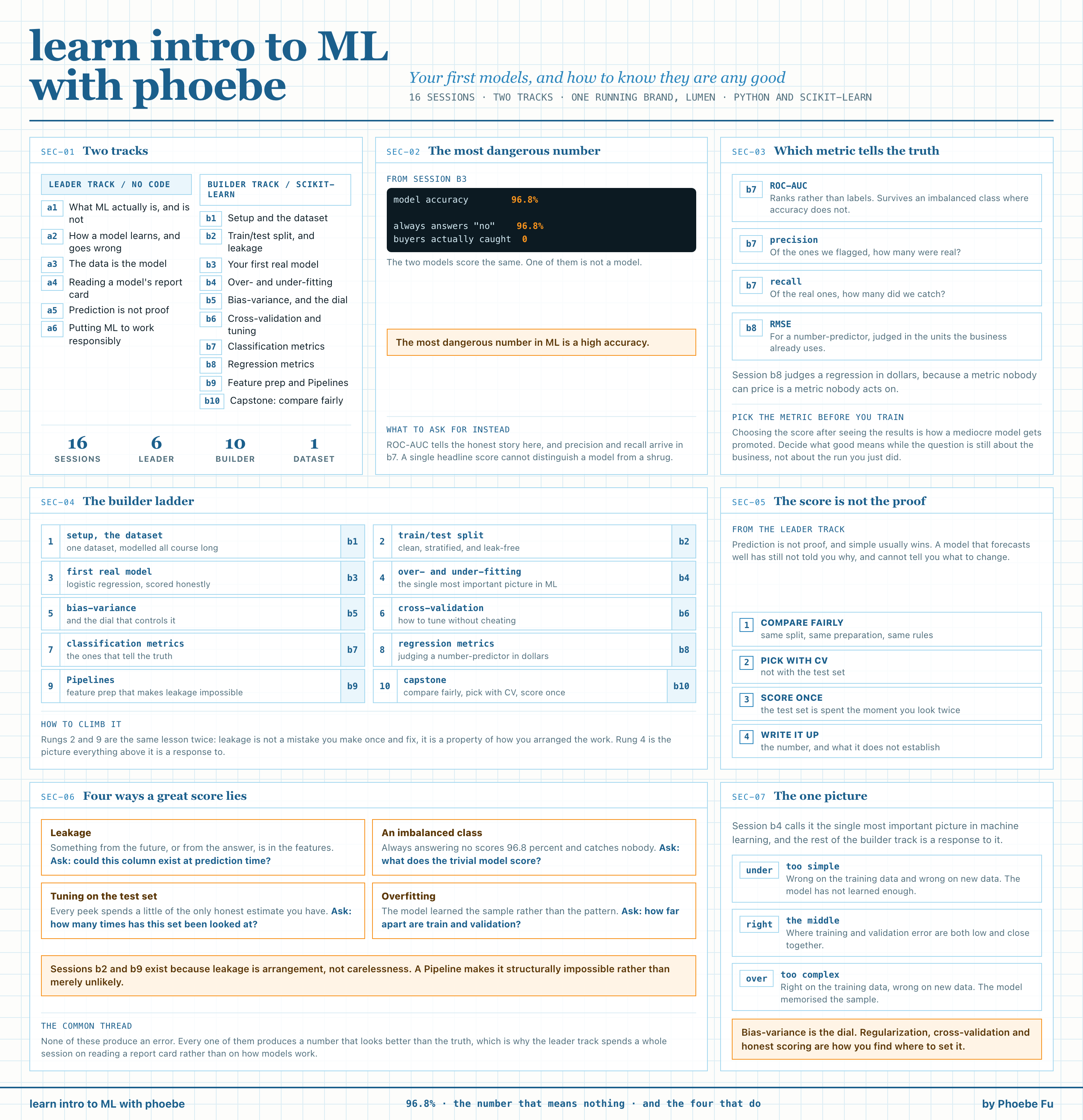
learn intro to ML
with phoebe
SEC-01 Two tracks
LEADER TRACK / NO CODE
- a1What ML actually is, and is not
- a2How a model learns, and goes wrong
- a3The data is the model
- a4Reading a model's report card
- a5Prediction is not proof
- a6Putting ML to work responsibly
BUILDER TRACK / SCIKIT-LEARN
- b1Setup and the dataset
- b2Train/test split, and leakage
- b3Your first real model
- b4Over- and under-fitting
- b5Bias-variance, and the dial
- b6Cross-validation and tuning
- b7Classification metrics
- b8Regression metrics
- b9Feature prep and Pipelines
- b10Capstone: compare fairly
SEC-02 The most dangerous number
The two models score the same. One of them is not a model.
ROC-AUC tells the honest story here, and precision and recall arrive in b7. A single headline score cannot distinguish a model from a shrug.
SEC-03 Which metric tells the truth
Choosing the score after seeing the results is how a mediocre model gets promoted. Decide what good means while the question is still about the business, not about the run you just did.
SEC-04 The builder ladder
Rungs 2 and 9 are the same lesson twice: leakage is not a mistake you make once and fix, it is a property of how you arranged the work. Rung 4 is the picture everything above it is a response to.
SEC-05 The score is not the proof
Prediction is not proof, and simple usually wins. A model that forecasts well has still not told you why, and cannot tell you what to change.
SEC-06 Four ways a great score lies
None of these produce an error. Every one of them produces a number that looks better than the truth, which is why the leader track spends a whole session on reading a report card rather than on how models work.